
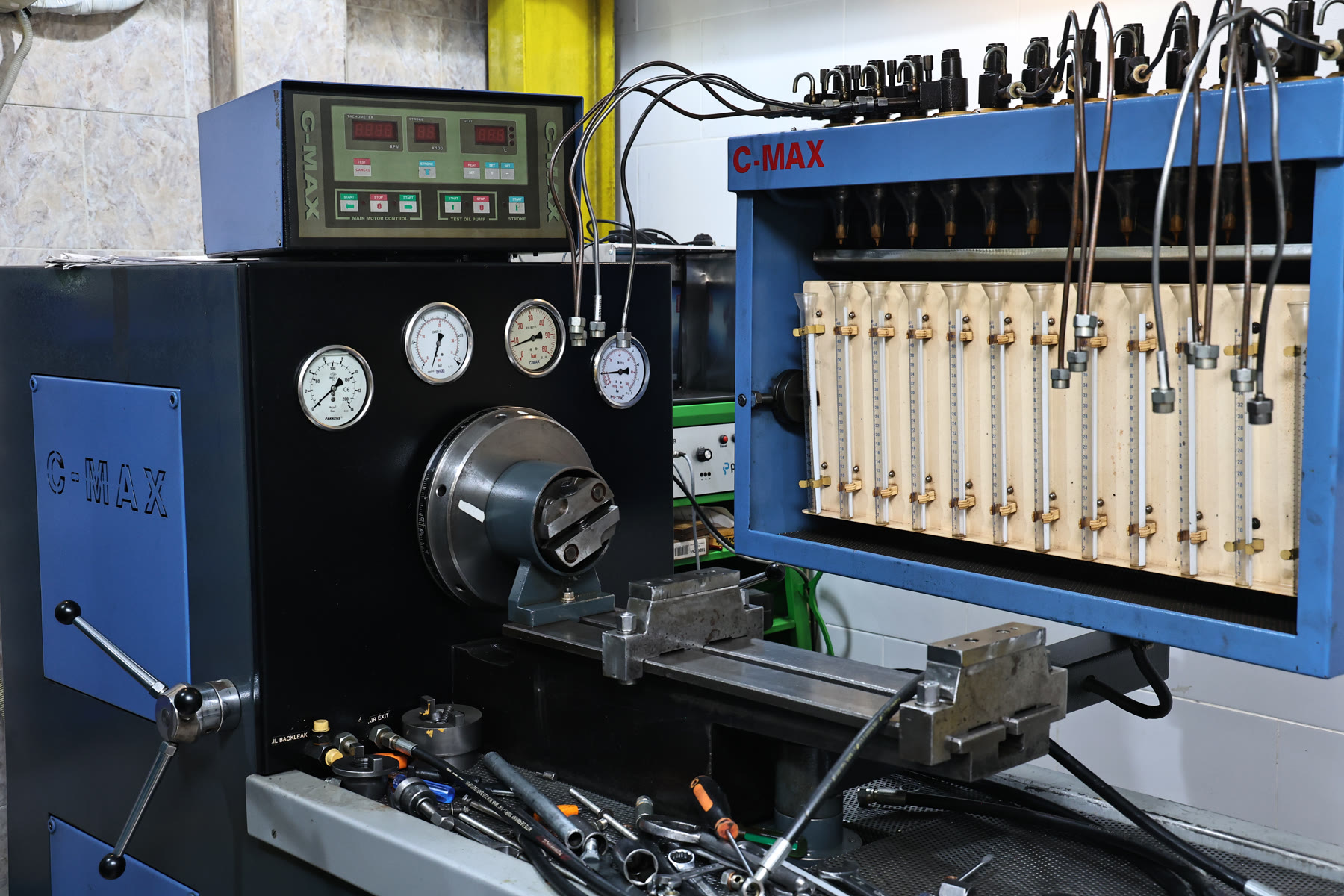
Pumps · injectors · common rail · governors
Diesel fuel injection service & calibration
Hard starting, black smoke, power falling away under load, a genset that will not hold frequency. We test the pump or the injectors before we quote, repair what the readings show, and hand the unit back with the figures on paper.
Start with what the engine is doing
Symptoms, and what they usually mean
A diesel fuel system cannot be judged by eye. A pump that looks perfect can be well down on delivery on one element; an injector that sprays can still be leaking back past the needle. Every row below is a measurement, not a guess.
| What the engine is doing | What it usually points at |
|---|---|
| Hard to start cold, fine once warm | Worn pump elements — enough delivery to run, not enough to start |
| Power falls away under load | Delivery down, or the governor not reaching full fuel |
| Black smoke that will not clear | Over-delivery on one or more elements, retarded timing, or worn nozzles |
| White smoke at idle | Late or uneven injection, or a nozzle dribbling after injection ends |
| Knocking from one cylinder under load | One injector out of specification |
| Runs, stops, needs bleeding to restart | Air entering on the suction side |
| Fuel consumption rising with no power gain | Excess injector return flow |
| Genset hunts or will not hold frequency | Governor, not fuel |
That is exactly what the bench is for, and it is the most common reason equipment arrives here. Send both if you can — testing them together removes the guesswork and avoids a second visit. What the test report tells you →
The full scope
What we work on
Named plainly, so you can ask for exactly what you need. If the operation you want is not listed, ask — this describes the common work, not the boundary of it.
Injection pumps
- Strip, rebuild and recalibrate inline and rotary distributor pumps
- Plunger and barrel elements, delivery valves and seats renewed
- Camshaft, tappet, roller, drive shaft, bearing and seal renewal
- Element phasing, port-closing and static timing set
- Bench calibration alone, for a pump rebuilt elsewhere or re-set after an engine change
Injectors & nozzles
- Incoming flow and spray test before anything is opened
- Ultrasonic cleaning and back-flushing; carbon removed with brass tooling
- Nozzle and needle replaced as a matched pair; springs and shims renewed
- Opening pressure set; spray pattern, chatter, seat tightness and back leak measured
- Delivery matched across a set, with a per-injector test sheet
Common rail
- On-engine return-flow test
- High-pressure bench test across the injection map
- Pilot, main and post quantity verification
- Control valve, nozzle and needle replacement; high-pressure pump strip and rebuild
- Calibration codes recorded and issued with the report
Governors
- Incoming run and record, then strip, flush and inspection
- Pilot valve plunger and bushing, compensating needle and land servicing
- Ballhead bearing, flyweight pivot, oil pump and relief valve overhaul
- Speed range, maximum-speed stop and droop set; compensation adjusted for stable response
- Terminal shaft travel matched to fuel rack travel, with a test record
Why it matters that the bench is ours
Most workshops in this market can strip and rebuild a fuel pump. Far fewer can set one, because setting it means owning the bench, the test data and the operator — and most subcontract that step. When the calibration goes out, your pump sits in a third party's queue, it goes out for rebuild rather than for measurement, and the adjust-run-measure loop that matches a set to each other becomes expensive rather than free. Every extra transfer of a precision assembly is another chance for dirt and damage, and the report is written by somebody you cannot ask. Here the unit is tested as received, worked on, retested and signed off without leaving the building.
The Gulf failure pattern
How diesel fuel systems fail here
The pattern in this region is not the European one, and it drives most of what comes through our door.
- Water and abrasives in the fuel
Condensation in half-empty tanks, humid air and long storage in ambient temperatures above 45°C all put water into diesel. Water strips the lubricating film between a plunger and its barrel, and between a needle and its seat. Those clearances are lapped as a matched pair — once scoring starts the element is scrap and must be replaced, not cleaned. Abrasive dust does the same job faster.
- Low lubricity fuel
Modern low-sulphur diesel carries less inherent lubricity than the fuel most older pumps were designed around. Rotary pumps suffer most, because the rotor is lubricated only by the fuel passing through it.
- Heat
An injection pump generates its own heat and sits in an already hot engine bay. On electronically controlled rotary pumps such as the Bosch VP44, the pump-mounted control unit is a known casualty of repeated heat cycling — the electronics fail while the hydraulic side is still serviceable.
- Contamination on common rail
At high rail pressure, a particle that would pass harmlessly through a mechanical system will cut a control valve seat. That is why common rail work has to be done in a clean area with dedicated tooling, not on the same bench as a dirty inline pump strip.
- Deferred filter changes
More fuel systems in this region are killed by an overdue filter than by age.
The commercial question
Repair or replace is a measurement, not an opinion
A new injection pump for a large industrial or marine engine is often a long-lead import at a price that makes the whole engine look uneconomic. In most cases it does not need to be bought.
Beyond economic repair when
The parts that cannot be renewed are gone
- The housing bores are worn beyond a repairable limit
- The cam or rotor is worn beyond a repairable limit
We say so before you spend money on a rebuild that will not hold calibration. That answer costs you a bench test and nothing else.
Repairable when
The wear is in the replaceable parts
- Plungers, barrels, delivery valves, nozzles, seals and drive components are all replaceable
- The pump body itself rarely fails
- The incoming test frequently shows one element at fault rather than the whole pump
- Sometimes it shows the pump is fine and the problem is somewhere else entirely
The useful first step is not a quote. It is a test.
What arrives here
Engines and equipment we cover
Marine main and auxiliary engines, generator sets, fire pump engines, air compressors, truck and bus engines, construction and heavy plant. Engine makes with real depth here are Caterpillar, Cummins and Perkins, plus MAN, Volvo, Yanmar, MTU, Deutz, Detroit, Wärtsilä and Kubota. Fuel-system component makers we work on: Bosch, Denso, Delphi, Stanadyne, and Zexel and Diesel Kiki.
Fuel system work rarely arrives alone. If the engine is already stripped, full engine repair and overhaul is run from the same site and the machine shop handles the crankshaft, block, head and rod work in the same building — so a single job number covers the whole engine rather than three suppliers and three schedules.
Annual maintenance contracts are available for customers running standby power, fire pumps or fleets that need fuel equipment kept in condition rather than fixed after it fails. Terms are set against your site and your equipment, so start with a conversation.
A clear photograph of the unit and its nameplate, with the engine make, model and serial, gets you a useful answer before transport or disassembly.
We hold no fuel-system brand dealership and we are not an authorised service centre for any manufacturer. Brand names appear here only to describe the equipment we repair. Established 2011, over 25 years of experience, ISO 9001:2015 certified.
Straight answers
Frequently asked questions
Do you actually calibrate on site, or do you send pumps out?
On site. The benches are in our own workshop in Industrial Area 15, and the people who set your pump are the people who stripped it. That is the single question worth asking every workshop you are comparing.
What do I receive when the job is finished?
The unit, plus a signed test report showing what was measured at each test point. See what our calibration report actually tells you.
How long does a pump or injector job take?
It depends on the unit and on parts availability, and we will give you a date once the incoming test tells us what the job actually is. Because nothing is subcontracted, that date is ours to keep rather than somebody else's to miss. If you are working to a deadline, say so when you call — the schedule is built around the jobs that have one.
How do you quote?
We quote after the incoming bench test, because until a unit has been run we are guessing. The test tells us which components are worn and what the parts will be. Nothing is stripped or ordered before you have agreed the work.
Are you an authorised Bosch or Denso service centre?
No. We are an independent specialist and hold no fuel-system brand dealership. We calibrate against manufacturer test data and publish what we measure.
Can you tell me whether it is the pump or the injectors?
That is exactly what the bench is for, and it is the most common reason equipment arrives here. Send both if you can — testing them together removes the guesswork and avoids a second visit.
Related
Where fuel system work connects
Send it to us to be tested
The fastest way to an answer is a measurement. Bring or send the unit with the engine make, model and serial and a photograph of the nameplate. If the vehicle or vessel is down now, phone — a pump on a bench today is a pump back on the engine sooner.