
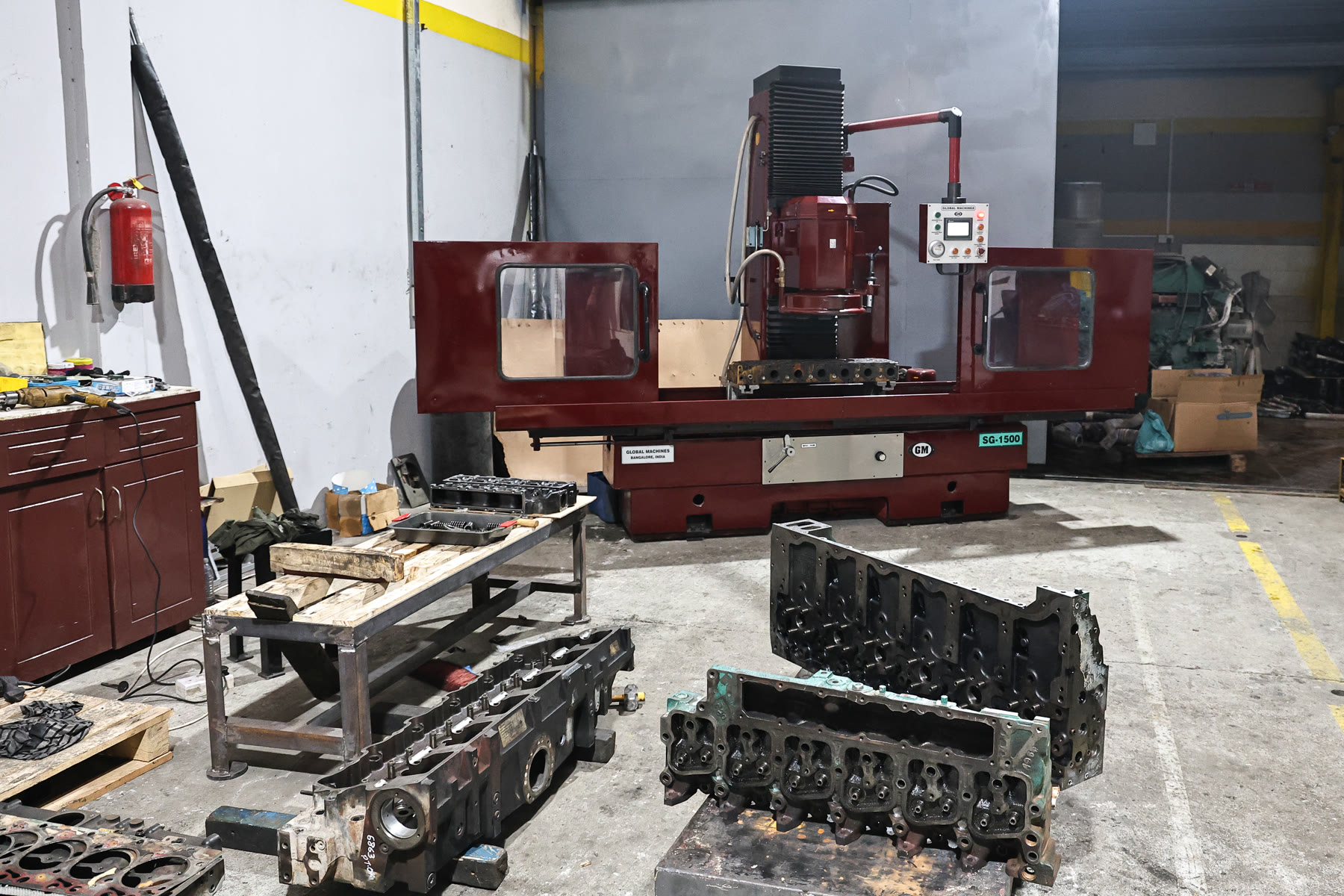
That is the whole argument of this page. Many workshops in the UAE that quote you for a crankshaft regrind or a line bore are quoting you for a subcontract — their margin, plus somebody else's shop, plus two extra transport legs and a queue you cannot see. When the work is under one roof, the measurement, the machining and the verification are done by people who answer to the same job card, and there is one phone number to call when you want to know where your part is.
Established 2011, with over 25 years of experience. ISO 9001:2015 certified. Independent — we hold no engine brand dealership, which is precisely why we have no incentive to sell you a new part when the old one can be measured, machined and returned to specification.
What "in house" actually buys you
It is easy to write "full machining facility" and mean a desk with a phone on it. Here is what owning the machines changes, in terms you can check.
One set of hands, one datum. A block that needs its mains line bored, its deck skimmed and its cylinders bored and honed is fixtured, measured and cut here in a planned sequence, off one datum. Split that work between two shops and every operation starts by guessing what the other shop did.
No hidden queue. When machining is subcontracted, your lead time is somebody else's workload plus two transport legs, and nobody in the chain will tell you what it is. Here, the answer to "where is my crankshaft" is a walk across the floor.
Fewer handling risks. Every additional journey is another chance for a machined face to be dropped, a journal to be knocked, or a stripped head to arrive with a cylinder's valves in the wrong bag. The parts that never leave the building never take that risk.
Diagnosis and machining in the same conversation. The person who measured the part is the person who cuts it. When an inspection turns up something the customer did not expect — a fillet crack, a bore already at its last oversize — you get told by the shop that found it, not by a middleman relaying a message.
You can come and look. The machine your job runs on is in this building and you are welcome to stand next to it. That offer is only possible for a shop that owns its equipment, and it is the fastest way to tell the difference between the two kinds of supplier.
Operations we perform
This is the menu. Every line is work carried out in our own shop, and every line is quoted after measurement — never before.
Crankshaft
- Crankshaft inspection and full journal measurement — diameter, taper, ovality, run-out
- Magnetic particle crack detection, including fillet roots
- Crankshaft grinding to standard undersize, mains and crankpins
- Fillet radius reproduction to the engine maker's radius
- Journal polishing to a bearing-ready finish
- Post-grind hardness verification
- Crankshaft straightening and run-out correction
- Thrust face regrinding
Cylinder block
- Block cleaning, degreasing and gallery clearing
- Block pressure test — before repair and again after
- Crack detection on decks, webs and water jackets
- Deck resurfacing to flatness and gasket-correct finish
- Cylinder boring to oversize
- Cylinder and liner honing, including plateau finishing
- Line boring of main bearing bores to a single centreline
- Align honing to final size and finish
- Main cap grinding to restore stock before boring
- Liner counterbore machining and liner protrusion setting
- Cylinder liner removal and fitting
- Crack repair by metal stitching and locking
- Head bolt and stud thread repair with inserts
Cylinder head
- Head stripping, cleaning and valve-by-cylinder bagging
- Crack detection on cast iron and aluminium heads
- Head pressure testing with hold time recorded
- Head face resurfacing to MLS or composite gasket specification
- Valve seat cutting, three-angle where specified
- Valve seat insert fitting
- Valve guide replacement and reaming to stem clearance
- Valve refacing and stem tip dressing
- Injector tube and sleeve replacement, with protrusion checked
- Valve spring free length and pressure checking
- Head reassembly and cold valve clearance setting
Connecting rods and pistons
- Big-end bore measurement with the cap torqued
- Big-end resizing to standard bore size and roundness
- Rod bend and twist checking on an alignment fixture
- Small-end bush removal, fitting and finishing to the actual pin
- Crack detection on beams and bolt bosses
- Rod set weight matching
- Piston and gudgeon pin measurement and ring groove checking
General machining
- Turning, facing, boring and knurling
- Internal and external threading, standard and non-standard pitch
- Shaft journal repair and shaft manufacture from bar
- Bush, sleeve, spacer and flange manufacture
- Keyway and slot cutting
- Flywheel machining
- Hydraulic press work — bushes, bearings, pins, gears
- Parts made from a sample or a sketch where no drawing exists
Fuel system work sits alongside the machine shop: see diesel fuel injection services for pump and injector calibration on our own test benches. Annual maintenance and service contracts are offered for fleet, plant and genset operators — the terms are agreed against your site and your engines, so ask and we will talk them through.
The services in detail
Crankshaft and rotating assembly
- Crankshaft grinding and regrinding — journals reground to undersize, fillets respected, polished and measured.
- Connecting rod boring and reconditioning — big-end resizing, small-end bushing, bend and twist checked.
- Piston reconditioning and ring groove repair — pistons measured, grooves and pin bores assessed before they go back.
- Dynamic balancing of crankshafts and rotors — rotating assemblies balanced rather than assumed.
Block work
- Line boring and main bearing bore alignment — the operation most UAE workshops subcontract.
- Engine block machining and repair — deck surfacing, boring, pressure testing, crack repair.
- Engine reboring and cylinder boring — bores taken to a clean oversize.
- Cylinder bore honing — crosshatch and finish set to the engine builder's spec.
Cylinder heads
- Cylinder head reconditioning — the full head workflow, from crack check to valve setting.
- Cylinder head surfacing and resurfacing — flatness and finish measured, not guessed.
General machining
- Lathe and turning works — turning, threading, facing and boring for one-off and small-batch parts.
- Milling and surface grinding — flat faces, slots and mating surfaces taken back true.
Repair or replace is a measurement, not an opinion
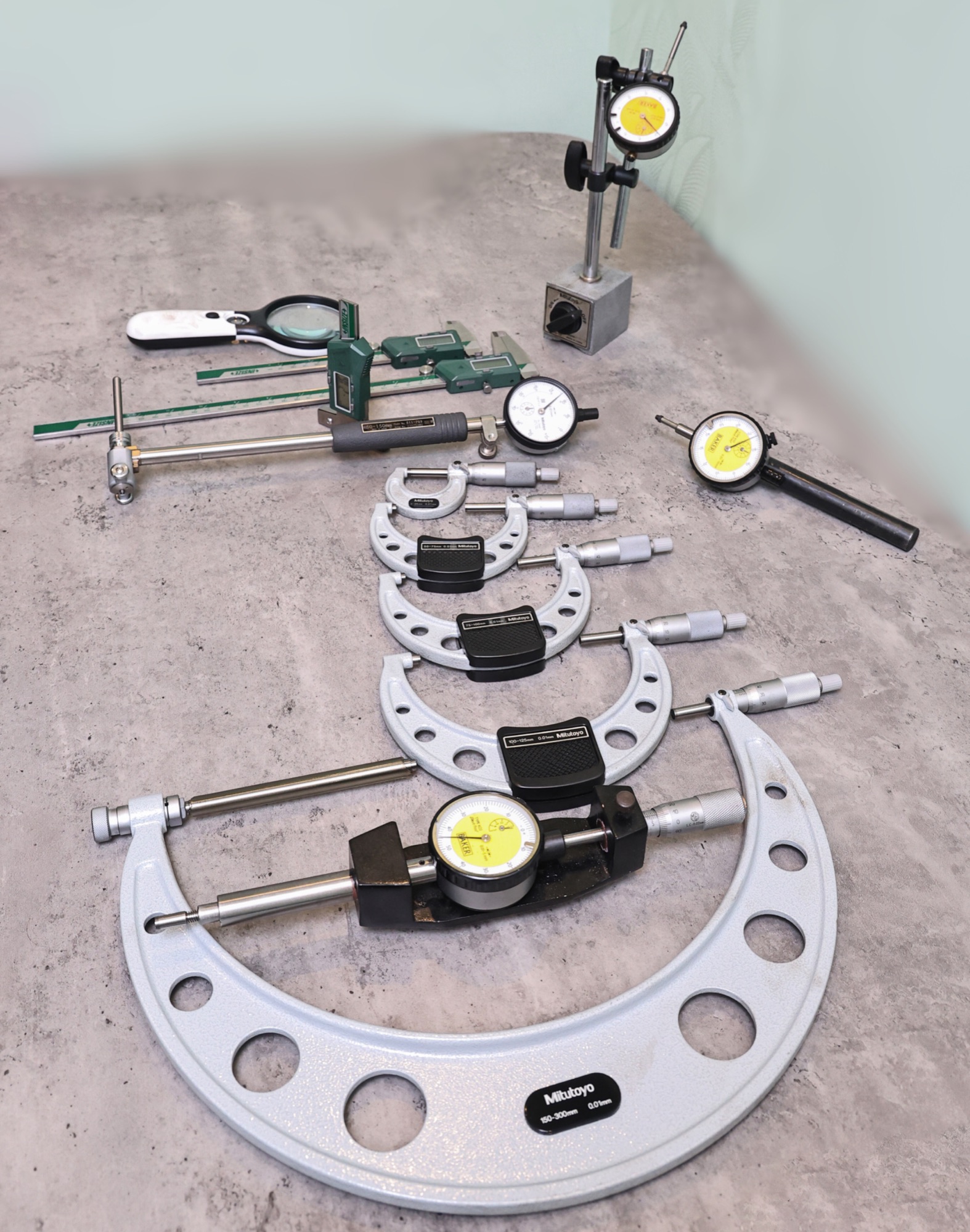
A worn crankshaft, a distorted head, a stretched rod and a cracked block all have the same two options behind them: buy new, or machine what you have. Most people are asked to make that decision on somebody's judgement. It is not a judgement. It is a set of measurements, and it can be settled in an afternoon.
Repairability depends on measurable condition — ovality, hardness, bend, crack depth, and how much material is left above the maker's bottom limit. Every one of those is a number, taken with an instrument, recorded on a sheet. A shop that owns the equipment can produce those numbers. A shop that brokers the work cannot, which is why it defaults to telling you to replace the part.
So the first thing to ask for is not a quote. It is a measurement.
The dealer path is quick to quote and slow to arrive. A large-bore crankshaft or a marine head is rarely on a shelf in the UAE; it is a factory order with a lead time, and the engine earns nothing through all of it. Machining uses the part you already have, and it starts the day it lands on the bench.
Machining is not always the right answer, and we will say so. A journal already at its last undersize, a head surfaced past the point where valve depth and injector geometry still work, a block cracked through a main web — these get an honest "replace it" from us, in writing, with the measurements that led to the conclusion. That verdict costs you the inspection and nothing else, and it is worth more to you than the machining fee we would otherwise have taken.
Engines we machine for
Caterpillar, Cummins, Perkins, Volvo, Scania, Mercedes-Benz, Mitsubishi, Yanmar, Iveco, Wärtsilä, Niigata, Tata and Ashok Leyland come through the shop regularly, in main-engine, auxiliary, generator, truck, bus, marine and fire-pump forms. Large Cummins families — KTA19, KTA38, KTA50 and NTA855 — appear often enough to be worth naming.
Capacity is broad. Small components, complete blocks, marine heads and large genset assemblies are all normal work here; genuinely tiny precision work we decline, and very large jobs are taken on with support arranged where that serves the customer better. If you are unsure whether your component fits, send a photograph and the engine model and you will have an answer the same working day.
We are an independent specialist. We do not hold a dealership for any of these brands.
How a job runs
- Arrival and identification. Engine model, serial number, component, and the failure as the customer describes it.
- Cleaning. Nothing is measured dirty.
- Inspection and crack detection. Magnetic particle inspection is the normal method for steel and cast iron components, because it finds sub-surface and fillet-root cracks that a dye penetrant will not. Dye penetrant is used where the part or the geometry does not suit magnetising.
- Measurement and report. Recorded against the engine maker's service limits, not against our opinion.
- Quote. Machining scope, price, and an honest replace-instead recommendation where that is the answer.
- You approve. Nothing is cut until you say yes, and if the scope changes once the part is open, you get a phone call before the machine is started again.
- Machining.
- Verification. The same measurements repeated after machining, on the same instruments.
- Return with the measurement sheet.
What you get back
A machined component, and a measurement sheet showing the before and after figures for every dimension we touched — journal diameters and the undersize cut, bore sizes and the oversize cut, deck and head flatness with the material removed, main bore alignment, pressure test results, crack test results. The sheet tells you what to order next, which bearing shells or pistons the part now takes, and it is the document the next engineer to open this engine will want.
Machining work is warranted. The cover depends on the operation and on whether we also supplied the parts and did the assembly, so it is confirmed in writing with your quotation rather than promised loosely on a web page.