
Planned preventive maintenance · across the UAE
Generator maintenance & preventive servicing
The work you do so that the set starts on the day the mains drop. Serviced to the engine manufacturer's schedule, with readings logged and a written report left behind at every visit.
We see what neglected maintenance costs
Most of the crankshafts on our grinder arrived because oil went unchanged, and most of the burnt stators in our winding bay were running hot long before they failed. That is the difference between a servicing company and a repair workshop selling servicing: the abrasive that gets past a poor air filter, and the oil left in past its interval, end up on our machines. We would rather sell you the filter.
The contracting convention
A, B, C and D service levels
UAE facilities contracts routinely specify servicing as A, B, C and D checks. The letters are a convention rather than a standard, so what matters is what each level contains. This is how the market generally understands them — useful when you are comparing quotations.
| Level | Typically due | What is done |
|---|---|---|
| A — inspection | Monthly, or after each mains-fail run | Visual inspection; oil and coolant level; fuel level and water in the primary filter; battery voltage, electrolyte and terminals; belts; leaks; controller alarm log read and cleared; off-load test start; readings recorded |
| B — routine service | The engine maker's short interval | Everything in A, plus oil and oil filter, fuel filter and water separator, air filter check, coolant condition and inhibitor, battery load test, charging alternator output, hoses and clamps, exhaust and silencer, anti-vibration mounts, on-load run |
| C — major service | The engine maker's long interval | Everything in B, plus air filter renewal, coolant change or inhibitor to specification, radiator core clean, valve clearances, injector spray-pattern check, turbocharger play and end float, panel connection torque check, alternator insulation resistance, breaker and protection function test, load bank test |
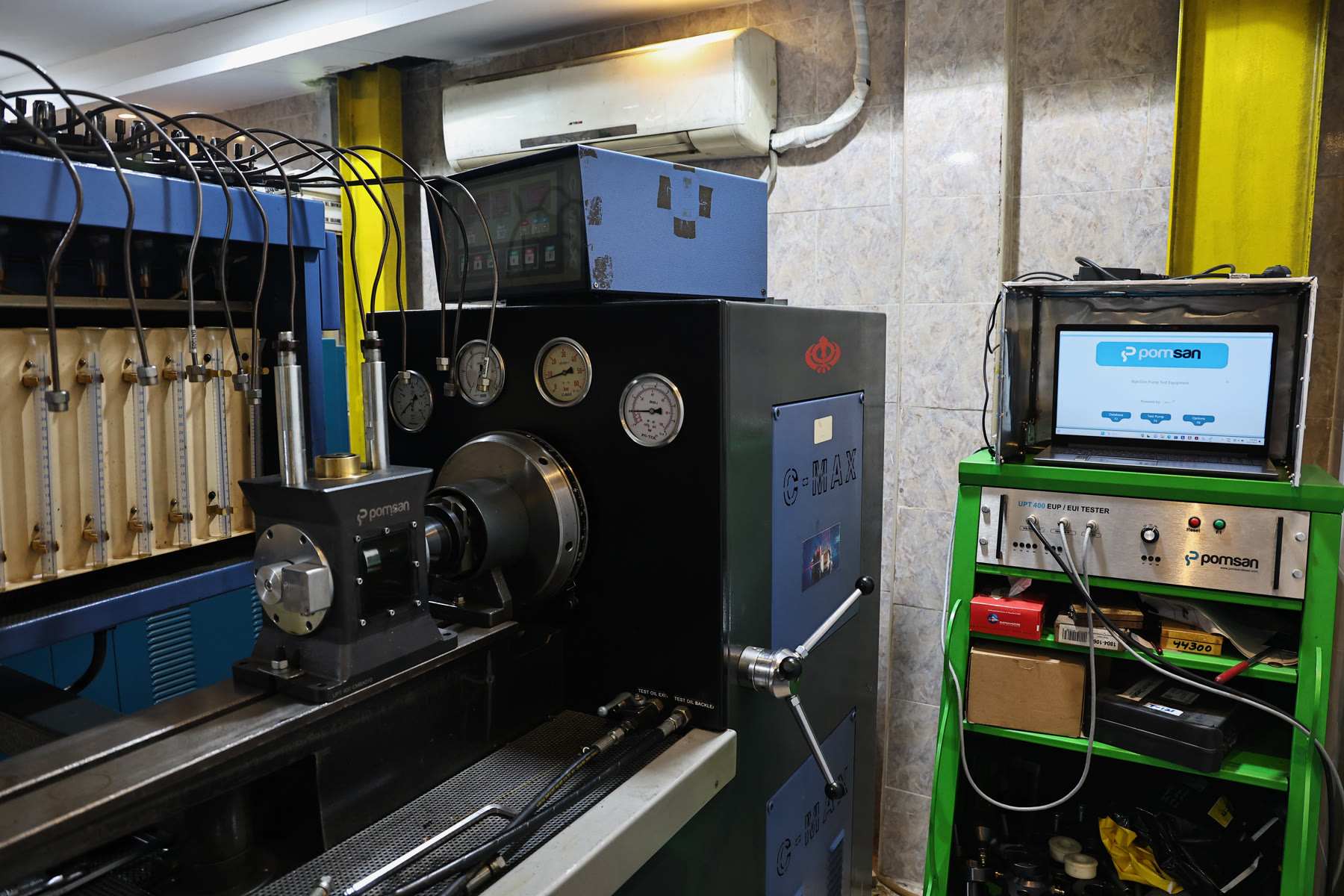
| D — heavy service | Long-hour sets, or on condition | Everything in C, plus injectors and fuel pump removed for bench testing and calibration, compression test, blow-by assessment, cooling system pressure test, oil sample analysis, and a written view on whether the set is heading for a top or major overhaul |
The governing document is the maintenance schedule in your engine's own manual, in this ambient. Send us the model and we service to that, not to a generic one. What gets done on your set is scoped against your set — its duty, hours and environment — and written down before the first visit. A supplier who cannot tell you which schedule they are working to is working to their own convenience. See AMC and maintenance contracts for how that scoping conversation runs.
Duty changes the schedule
Standby, prime and continuous
A set's rating governs how hard it may be worked, and therefore how often it needs attention. ISO 8528-1 defines four.
A standby set that runs twenty hours a year will never reach a running-hours interval — which is exactly why standby sets are the ones that fail. Time degrades coolant inhibitor, oil additive packages, batteries, rubber and diesel just as surely as running hours do. A standby set needs a calendar schedule and an annual proving load test, not an hour-meter schedule. Lightly loaded sets also need watching for wet stacking — see load bank testing.
45–50 °C, dust and warm fuel
Three things that are harder here
Cooling
Ambient sets the floor for coolant temperature. A core half blocked with dust and airborne sand is survivable in a European winter and a shutdown in a Sharjah August. Core cleaning is the difference between a set that carries its rating and one that derates or trips.
Fuel
Warm tanks with a large air space condense water. Water plus warmth plus diesel grows microbial contamination, which blocks filters, corrodes tank floors and puts abrasive debris through injection equipment. Draining the trap and sampling the tank is routine here.
Batteries
Heat shortens lead-acid life sharply. A failed start on a standby set is more often a battery or a charger than an engine.
Air filters
They load up for the same reason the radiator core does, and a loaded filter has the same practical effect as a further derate on the set's output.
On the day
What a service visit looks like
Arrive, isolate, make safe
Confirm the set's duty and whether it is on automatic. Inhibit the AMF or ATS with the site's permission where an unplanned start cannot be tolerated.
Cold checks and readings
Oil, coolant, fuel, battery, belts, hoses, leaks, exhaust, mounts, guards — and the controller's alarm and event log, where the last three months of real history is written.
The service work
Oil and filters, coolant, air filter and whatever the level calls for. See oil and filter change for the grade and filter policy.
Run and load
Voltage on all phases, frequency, current, oil pressure, coolant temperature, battery and charging voltage — then again under load where the site allows. A set only ever run off-load has never been tested.
Report and priorities
Written record of readings, work done, parts fitted, and anything found that needs attention with a priority against it.
Deliverables
What you get after every visit
- A service report listing readings taken, tasks completed and parts fitted
- Photographs of anything we are recommending you act on
- A dated record you can hand to an FM client, an insurer or an auditor
- A running log across visits, so a slow drift in oil pressure or coolant temperature is visible before it becomes a shutdown
The report is a deliverable, not a courtesy. If a supplier leaves nothing behind, there is no way to know what was done and no baseline for the next visit.
Parts and oil
The oil grade and filter specification come from the engine manufacturer's manual for that engine, in this ambient — not from whatever is on the van. What was fitted is recorded on the report by part number, so you can check it rather than take it on trust. Where a component is available in more than one grade, the options and the difference are written on the quotation rather than decided quietly on your behalf. A service that looks cheaper is often one where that decision was taken for you.
The boundary
When maintenance stops being enough
Maintenance manages wear. It does not reverse it, and the point at which a set moves from servicing to repair usually announces itself.
- Oil consumption rising visit on visit, with blow-by at the breather
- Oil pressure falling at rated speed and operating temperature
- Coolant temperature climbing on the same load, after the radiator has been cleaned
- Exhaust smoke that does not clear once warm
- Voltage or frequency that will not hold steady when load is applied
At that point the set has moved into diesel generator repair, and the symptoms are worked through on generator troubleshooting. When they appear together on a high-hour engine the conversation is a generator overhaul, and the useful next step is a full set of measurements rather than another oil change.
Common questions
Generator servicing, answered
How often should a diesel generator be serviced?
By hours or by calendar, whichever comes first. A working set follows the engine manufacturer's hour intervals. A standby set that barely runs still needs servicing on the calendar, because oil, coolant inhibitor, batteries and fuel degrade with time. Send the engine model and duty and we will tell you the interval that applies to your set rather than a generic figure.
What is generator PPM?
Planned preventive maintenance — a fixed schedule of visits agreed in advance rather than waiting for a fault. In the UAE facilities market PPM is usually written into the contract with defined visit frequencies and a report per visit. That is what a generator AMC formalises.
What are A, B, C and D checks on a generator?
Four escalating levels: A is an inspection, B is a routine service with oil and filters, C is a major service that adds coolant, valve clearances and testing, and D adds fuel injection equipment testing and condition assessment. The letters are a contracting convention rather than a published standard, so always check what a supplier puts in each level before comparing prices.
Do I need a load test as part of maintenance?
If the set is standby and rarely carries real load, yes. Off-load running proves the engine starts; it does not prove the set will carry the building. An annual load bank test proves that, and clears unburnt fuel out of a lightly loaded set at the same time.
Can you service the generator without shutting the site down?
Usually. Most of an A or B service happens with the set at rest and the mains carrying the site. What needs planning is the on-load run and any work on the AMF or ATS, because that is when the changeover is exercised. We agree that window before the visit.
Do you maintain generators you did not supply?
Yes — we supplied almost none of the sets we look after. We are an independent repairer with no brand dealership, and we service the common genset engine and alternator combinations. Details on generator repair and service.
Book a service
Send the engine model, alternator model, rating and running hours. You get back the correct schedule for that engine — and if the set needs a repair before it needs a schedule, we say so first. Open 7 days, 07:00–20:00.